Zhengzhou Yishang Machinery Equipment Co., Ltd.
Zhengzhou Yishang Machinery Equipment Co., Ltd.
Essential Considerations for Installing an 8-10 T/H Dry Mortar Production Line Indoors
 2025-12-30

Installing a dry mortar production line with a capacity of 8-10 tons per hour indoors presents unique challenges and opportunities. Proper planning is critical to ensure efficiency, safety, product quality, and long-term operational success. Here are the key factors to consider for an optimal indoor installation, designed to meet industrial standards and ensure reliable performance.
1. Site Planning and Structural Integrity
Space Optimization: Conduct a detailed layout analysis. Allocate sufficient space for the main production tower (mixer, silos, conveyors), raw material storage (sand, cement, additives), finished product storage, packaging stations, and maintenance access. Consider the flow of materials and personnel to minimize bottlenecks. Plan for potential future expansion.
Floor Load Capacity: Indoor floors must support the immense weight of loaded equipment, especially bulk silos (cement, fly ash) and the sand hopper. A professional structural engineer must assess and specify necessary foundation reinforcement, often requiring reinforced concrete piers or a continuous raft foundation.
Headroom and Vertical Clearance: Precisely calculate the total height of the production line, including silos, dust filters, elevators, and support structures. Ensure adequate clearance from roof trusses, lighting, ventilation ducts, and sprinkler systems. Vertical integration is key in indoor spaces.
2. Material Handling and Storage Systems
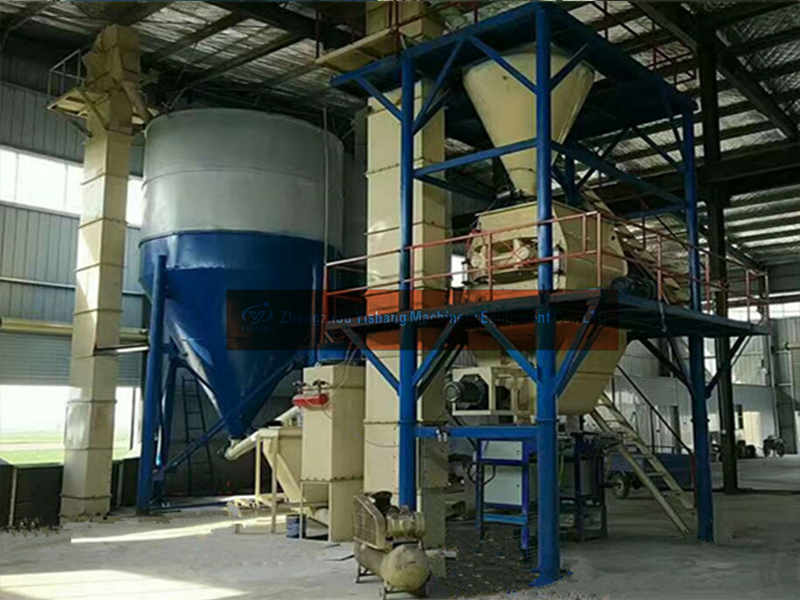
Sand Pre-processing: For consistent quality, an integrated sand drying and screening system is often necessary. If located indoors, this unit requires exceptional dust control, efficient thermal management, and dedicated ventilation or exhaust to handle hot, moist air.
Silo Placement and Support: Position bulk silos strategically. They may require independent structural support that transfers load directly to the foundation, bypassing the building floor. Ensure silos are equipped with high/low-level indicators, pressure relief valves, and anti-bridging devices (e.g., fluidizers, vibrators).
Dust-Free Conveying: Use fully enclosed conveying systems like bucket elevators and tube screws to transport materials between stages. This minimizes indoor dust generation and material loss.
3. Core Production Equipment Configuration
Mixer Selection: A high-shear horizontal ribbon mixer is ideal for this capacity range indoors. Prioritize models with a short mixing cycle, high homogeneity (CV<5%), rapid discharge, and easy access for maintenance and cleaning.
Precision Batching: Implement a multi-stage, computer-controlled weighing system. Use load cells for major ingredients (sand, cement) and highly accurate micro-feeders for additives (cellulose, redispersible polymer powder). Isolate weighing frames from structural vibrations.
Automated Process Control: A central PLC-based control system is non-negotiable. It should manage recipe formulation, production sequencing, real-time monitoring, data recording, and provide diagnostic alerts. The control room should be placed in a clean, low-vibration area.
4. Comprehensive Dust Collection and Ventilation
Centralized Dust Management: This is the most critical aspect of an indoor dry mortar plant. Design a centralized dust collection system with ductwork connecting all potential dust points: silo vents, mixer inlets/discharges, packing heads, and conveyor transfers. Use high-efficiency pulse-jet bag filters with automatic cleaning cycles.
Air Quality and Ventilation: Supplement the dust collection with a general ventilation system to control ambient temperature, reduce humidity, and provide fresh air exchange for personnel comfort and safety. Proper airflow also helps manage residual dust.
5. Electrical, Pneumatic, and Safety Systems
Power Distribution: Ensure a robust, clean power supply with adequate capacity for all motors, heaters (if present), and control systems. Use cable trays and conduits for organized, safe routing. All equipment should have appropriate IP ratings for a dusty environment.
Pneumatic System: Provide a dedicated, moisture-free compressed air supply for pneumatic valves, cylinders, and dust collector pulsing. Include air dryers and filters.
Safety First: Install guards on all rotating machinery. Provide fixed ladders, platforms, and guardrails for elevated access. Clearly mark emergency exits and safety zones. Implement lockout/tagout (LOTO) points.
6. Logistics, Packaging, and Noise Control
Inbound/Outbound Logistics: Plan for efficient truck access for raw material delivery (e.g., cement tankers) and finished product pickup. Consider screw conveyor or blower systems for transferring powders from trucks to indoor silos to avoid dust.
Packaging Area: Locate valve bag packers or bulk loading stations near storage or dispatch areas. Integrate check-weighers and palletizing systems for streamlined operation.
Noise Abatement: Indoor acoustics amplify noise from mixers, conveyors, and compressors. Use vibration dampeners, acoustic enclosures for loud equipment, and sound-absorbing wall/ceiling panels where necessary.
7. Regulatory Compliance and Future-Proofing
Permits and Codes: Secure all necessary building, electrical, environmental, and fire safety permits before installation. Compliance with local OSHA-equivalent regulations is mandatory.
Fire Prevention: Install monitoring and suppression systems, particularly near the dryer (if present) and control panel. Use explosion vents on silos where applicable.
Maintenance Access: Design the layout with ample space around equipment for routine service, inspection, and part replacement. This reduces downtime and improves safety.
Conclusion
A successful indoor installation of an 8-10 T/H dry mortar production line hinges on meticulous planning that prioritizes structural integrity, airtight dust containment, process automation, and operator safety. By addressing these considerations, you create a clean, efficient, and sustainable production facility capable of delivering consistent, high-quality dry mortar mixes while protecting both your investment and your workforce. Partnering with an experienced dry mortar mixing plant .mp4 manufacturer who understands indoor constraints is highly recommended for optimal results.

Whatsapp:++8615137127837
WechatID:+8615137127837
Email:[email protected]
Alibaba Store:
https://zzyishang.en.alibaba.com


 ++8615137127837
 +8615137127837

 Alibaba Store
